◆ 電壓電流 (Voltage & Current)
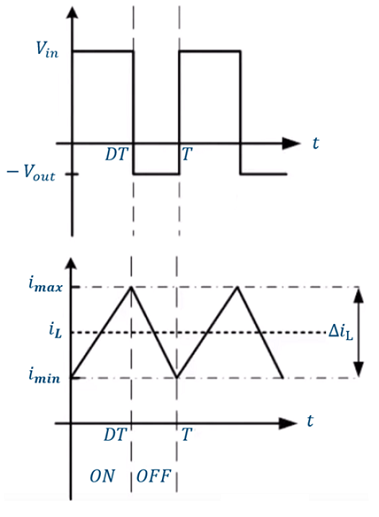
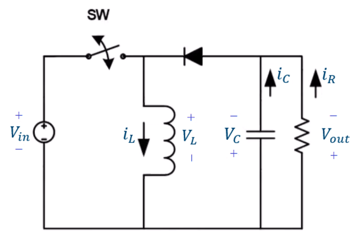
• In a Buck-Boost Converter, the derivation of the Duty Cycle (𝐷) is fundamentally based on the Inductor Volt-Second Balance principle
• The principle states that: In a steady-state switching regulator, the net change in inductor current over a complete switching cycle must be zero
• In other words, the average voltage across the inductor over one full period is equal to zero
◆ Volt-Second Balance
• Applying Volt-Second Balance to Derive 𝐷
In steady-state operation, the net change in inductor current over one period must be zero ( Δ𝑖𝑜𝑛 + Δ𝑖𝑜𝑓𝑓 = 0 ), implying that the integral of the inductor voltage over time is zero:
Substituting the voltages and time intervals for both states:
· 𝑉𝐿(𝑜𝑛) ⋅ 𝑡𝑜𝑛 + 𝑉
· 𝑉𝑖𝑛 ⋅ 𝐷𝑇 + ( −𝑉𝑜𝑢𝑡)⋅( 1−𝐷 )𝑇 = 0
Divide both sides by the switching period 𝑇:
· 𝑉𝑖𝑛 ⋅ 𝐷 + ( −𝑉𝑜𝑢𝑡) ⋅ ( 1−𝐷 )=0
Expand the terms:
· 𝑉𝑖𝑛 ⋅ 𝐷 − 𝑉𝑜𝑢𝑡 + 𝑉𝑜𝑢𝑡 ⋅ 𝐷 = 0
Cancel out the 𝑉𝑖𝑛 ⋅ 𝐷 and − 𝑉𝑖𝑛 ⋅ 𝐷 terms:
· 𝑉𝑖𝑛 ⋅ 𝐷 − (1−𝐷)⋅ 𝑉𝑜𝑢𝑡 = 0
· 𝑉𝑖𝑛 ⋅ 𝐷 = 𝑉𝑜𝑢𝑡 ⋅ (1−𝐷)
Duty Cycle 𝐷:
· 𝐷 = 𝑉𝑜𝑢𝑡 /( 𝑉𝑖𝑛 + 𝑉𝑜𝑢𝑡 )
🔗 延伸閱讀: 更多資訊請參考 「Buck Converter」, 「Boost Converter」, 「Buck-Boost Converter」, Control Mode


